


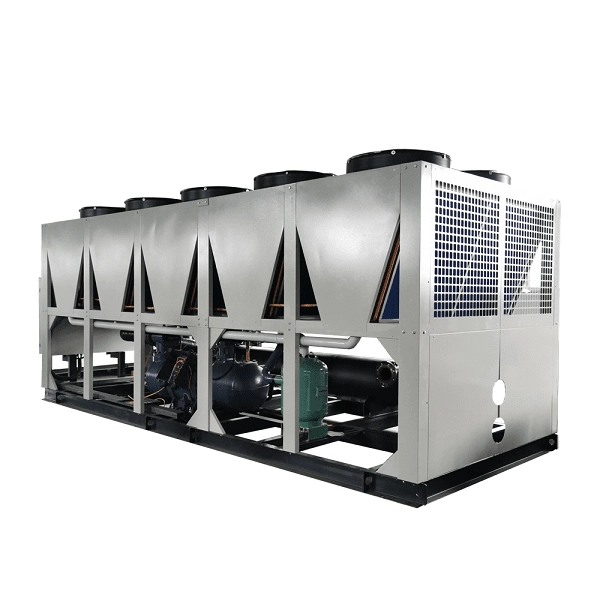
A compression chiller is a fundamental component in building cooling systems, tasked with cooling water for HVAC systems or industrial processes. These units are available in air-cooled and water-cooled designs.
In an air-cooled compression chiller, the refrigerant is cooled by air using condenser fans. The primary components of an air-cooled chiller, which cools water, include the evaporator, compressor, condenser, and expansion valve.
The operation of an air-cooled compression chiller is as follows: first, warm water enters the chiller and flows into the evaporator. Inside the evaporator, refrigerant in copper tubes absorbs the heat from the water, cooling it before it is transferred to the air handler or fan coil. The warmed refrigerant then moves to the condenser section to reduce its temperature.
In an air-cooled chiller, the condenser contains air-cooled heat exchangers arranged in a V shape, with refrigerant flowing through the convoluted tubes. Fans positioned above the condenser draw air through the heat exchanger, removing the excess heat from the refrigerant and expelling it into the atmosphere. The now-cooled refrigerant returns to the evaporator, where it absorbs heat from the incoming warm water, thus cooling it.
- A compression chiller with an air-cooled condenser is typically installed in outdoor spaces such as rooftops or courtyards of a building.
- The air-cooled compression chiller is preferred due to its adaptability to various climatic conditions, conservation of water resources, and ease of maintenance.


