


Hygienic air handling units (AHUs) are specially designed for sensitive environments such as hospitals, pharmaceutical centers, and specific industrial spaces. They differ significantly from industrial AHUs in terms of profile, fans, structure, filtration, and other features.
In hygienic AHUs, angles of 90 degrees, seams, and any areas where mold and bacteria could grow are minimized as much as possible. Airborne particles are filtered to meet the cleanroom (controlled environment) standards using high-efficiency filters specific to hygienic AHUs. Additionally, the use of UV lamps and chambers is another measure to purify the outgoing air.
The primary distinction of hygienic AHUs from other air handling units is the quality and specifications of the outgoing air. Hygienic AHUs are used in conjunction with cooling devices like chillers or heating devices like boilers because the AHU itself does not generate heat or cooling; it is solely responsible for distributing conditioned air.
In this system, water is chilled in the chiller or heated in the boiler and then pumped through the coils (finned copper tubes) of the AHU. A fan then blows fresh air over the coils, which cools or heats the air depending on the temperature of the coils. Air filtration typically occurs before the coils to ensure clean air and to prevent dust accumulation and deposits on the coils.
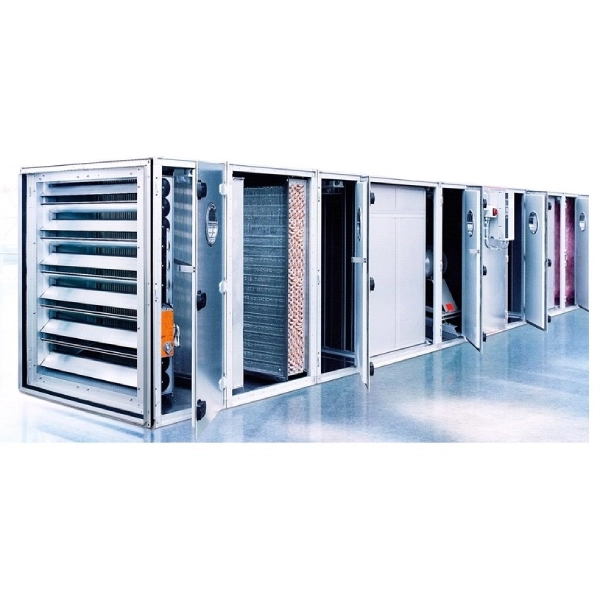
Product name: Hygienic air handling unit
The chassis of all air handling units (AHUs) is designed and manufactured from steel sheets suitable for the device's weight and is coated with either electrostatic powder paint or liquid paint. All components of the AHU are mounted on this chassis. The structure of hygienic AHUs is assembled using anodized aluminum profiles connected by specific corner brackets and mounted on the main chassis. The internal body is made of stainless steel, while the external body is made of hot-dip galvanized steel with an electrostatic paint coating. Insulation of appropriate thickness is placed between the two layers and mounted on the structure.
The fan used in this product is of the plug fan type. The motor power, fan size, and speed are selected based on external and internal pressure drops, airflow volume, and speed across the coils, as well as the type and number of filters used. Filters have different pressure drops depending on their cleanliness and dirtiness, so the fan speed should be adjusted accordingly. To accommodate this, using an inverter for the fan motor in hygienic AHUs is essential.
Filters are chosen based on cleanroom class requirements, and to extend the lifespan of bag filters, G2-G3-G4 filters are used. For increasing the lifespan of HEPA filters, various efficiencies of bag filters are used according to needs. To ensure filter cleanliness and monitor filter dirtiness or replacement time, DPS and DPT controllers with displays are employed. Both systems are capable of integration with inverters, electrical panels, and AHU controls. Filter dirtiness is monitored and reported intelligently.
Components of Hygienic Air Handling Units:
- Cooling and Heating Coils
- Air Filters
- Sound and Vibration Dampers
- Fans
- Electric Motors
- Smart Control System
- Ultraviolet Chamber
After completing the design stages, the cooling and heating loads, air flow rates, types of filters, and required static pressure and humidity levels are determined. At this stage, the design and construction of the air handling unit can proceed.
Product price:
call
Why Us?


